21
陳雨星
Yuxing Chen
The Oriental Scene
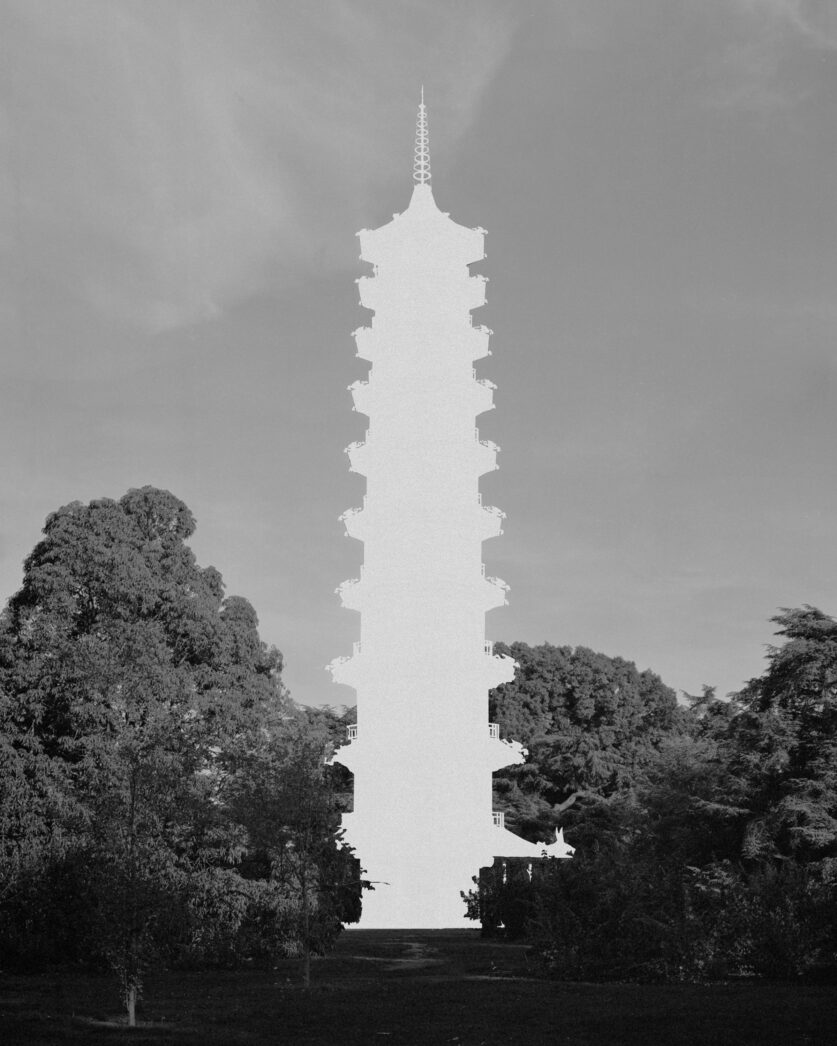
The Oriental Scene investigating Chinoiserie architecture in the UK under a de-colonialism, centring on the Porcelain Tower of Nanjing replica at Kew Gardens. The project reveals how cultural symbols are recontextualised over time by analyzing historical archives, documents, and the conflicting Pagoda storey counts in Eastern and Western depictions. Through photography and the juxtaposition of historical and contemporary works, it questions Orientalism’s role in shaping visual narratives and highlights the tension between reality and representation, inviting a critical reassessment of cultural imagery.
In the late 17th century, Europe became fascinated with ‘Oriental’ design and developed Chinoiserie. During the Baroque and Rococo periods, this trend influenced various fields from architecture to furniture, adapted according to European tastes. In the 17th and 18th centuries, the British began to promote this aesthetic and incorporated elements of Chinoiserie into their architectural designs and interiors.
During that time, Sir William Chambers built a replica of the Porcelain Tower of Nanjing at Kew in 1762, which was destroyed by the Taiping army in 1856. No photographs of the Porcelain Tower were left before photography was widely used. There are subtle differences in the depiction of the Porcelain Tower in the imagery preserved in the East and West, leading to misunderstandings; for example, the number of storeys of the Porcelain Tower is shown in European prints and book illustrations in both nine- and ten-storey versions. However, according to Chinese Han Buddhist tradition, in most cases, the pagoda must have an odd number of storeys, and the Nanking Tower is nine. The fact that Kew’s Pagoda has ten storeys raises the suspicion that it has been misrepresented by the image, showing a slightly paradoxical relationship between reality and fiction.
The artist visited and researched Chinese architecture in royal and upper-class gardens in England to explore the significance of architectural symbols as symbols of Eastern culture and to reflect on the process of knowledge production in the West when depicting the cultural ‘other’. The project in a contemporary presentation of the images, and through the transformation of oriental elements, revealing the West's gaze on the Orient, and emphasising the important role of photography in shaping historical imagery and collective memory.
WarmUp Kyoto [THE PATH Studio]
582-4 Hanabatakecho, Shimogyo-ku, Kyoto, Kyoto 600-8831, Japan
Open: 4.18 Sat.–4.26 Sun.
Open Everyday
13:00 - 18:00
入場無料 | Free